DDR4 vs DDR5 RAM: Which RAM Should You Choose for Your PC Build?
DDR4 vs DDR5 RAM in Bangladesh: Which Memory Standard Should You Buy for Gaming, Productivity & Future Upgrades?
Choosing between DDR4 and DDR5 RAM in 2026 is a critical decision for anyone building or upgrading a PC in Bangladesh. This technical comparison analyzes local pricing, architectural differences, and real-world performance benchmarks to guide your next component purchase.
DDR4 vs DDR5 at a Glance – Quick Comparison Table
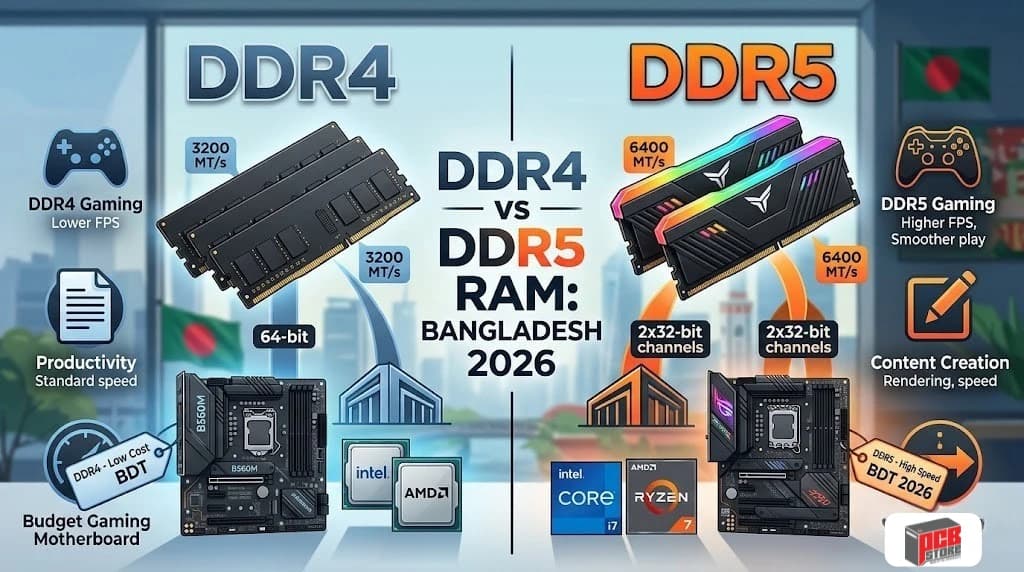
DDR5 memory provides double the maximum bandwidth and lower operational voltage compared to DDR4, while DDR4 retains a major pricing advantage in the local Bangladeshi market.
Key Specification Differences
The generational shift from DDR4 to DDR5 introduces major architectural updates, including on-die error-correcting code (ECC) and integrated power management.
Feature | DDR4 Specification | DDR5 Specification |
Standard Speeds | 2133 MT/s to 3600 MT/s | 4800 MT/s to 7200+ MT/s |
Operating Voltage | 1.2V (Standard) | 1.1V (Standard) |
Power Management | Controlled by Motherboard | Integrated on DIMM (PMIC) |
Channel Architecture | 1x 64-bit Channel | 2x 32-bit Channels |
On-Die ECC | Not Supported | Supported |
Max Module Capacity | 32 GB | 128 GB |
Performance Summary
Data transfer rates and workload processing efficiency scale significantly higher with DDR5, though gaming gains depend heavily on processor choices.
Workload Type | DDR4 Performance Level | DDR5 Performance Level |
1080p Gaming | Baseline Performance | 10% to 15% Higher Frame Rates |
4K Gaming | Identical to DDR5 | GPU-Bound Limit (0-2% Delta) |
3D Rendering | Standard Render Times | 15% to 20% Faster Processing |
AI Data Workloads | Heavy Bottlenecks | Highly Optimized Throughput |
Price Comparison in Bangladesh
The retail cost of memory kits in Bangladesh fluctuates based on brand imports, but the structural price gap between generations remains stable.
Component Configuration | DDR4 Price Range (BDT) | DDR5 Price Range (BDT) |
8GB Single Module | BDT 6,700 – 9,500 | BDT 12,500 – 15,500 |
16GB Single Module | BDT 13,000 – 16,500 | BDT 21,500 – 32,000 |
32GB Dual-Channel Kit | BDT 24,000 – 33,000 | BDT 44,000 – 65,000 |
What Is DDR RAM and Why Does It Matter?
DDR RAM acts as the high-speed workspace for your processor, holding active data to prevent severe system slowdowns. It bridges the performance gap between ultra-fast CPU cache and slower storage drives like solid-state drives.
Understanding System Memory
System memory utilizes Double Data Rate (DDR) technology to transfer data on both the rising and falling edges of the clock signal. This process doubles the data transfer capability without increasing the internal clock frequency of the memory bus.
- Volatile Storage: RAM loses all stored data instantly when the computer powers down.
- The Bottleneck Guard: Slow memory forces modern multi-core processors to wait for data, reducing overall system efficiency.
- Generation Barriers: DDR generations are physically distinct, meaning DDR4 modules cannot fit into DDR5 slots.
How RAM Affects Gaming and Productivity
Memory performance directly regulates frame pacing in modern video games and dictates file rendering speeds in heavy creative software.
- Gaming Impact: Faster RAM stabilizes minimum frame rates, reducing sudden stuttering during intense physics or open-world asset loading.
- Productivity Throughput: Video editing, 3D compilation, and heavy multitasking require massive data bandwidth to keep processor cores fully saturated.
RAM Speed vs Capacity
System responsiveness requires an optimal balance between total memory capacity and the raw speed of data transmission.
Aspect | Memory Capacity | Memory Speed |
Primary Metric | Measured in Gigabytes (GB) | Measured in MegaTransfers per second (MT/s) |
Core Function | Dictates how many programs can open simultaneously | Dictates how fast data transfers to the processor |
Shortage Symptom | System freezes, crashes, or forces disk paging | Lower frame rates and slower file export times |
2026 Target | 32 GB is standard for modern configurations | 3200 MT/s (DDR4) or 6000 MT/s (DDR5) |
What Is DDR4 RAM?
DDR4 RAM represents the fourth generation of synchronous dynamic random-access memory, serving as the industry standard since 2014. It operates at a baseline voltage of 1.2V and tops out at official standard speeds of 3200 MT/s.
DDR4 Architecture
The structural layout of DDR4 relies on a single 64-bit wide data channel per memory module. It features a traditional 16-bank memory structure divided into 4 distinct bank groups to manage system data requests.
- Motherboard Regulation: Voltage conversion and power delivery are managed entirely by the motherboard circuits.
- 8n Prefetch Depth: The memory architecture fetches 8 bits of data per internal access cycle.
- Physical Keying: The notch on the 288-pin connector sits closer to the edge, preventing insertion into newer slots.
Advantages of DDR4
DDR4 remains highly relevant due to its mature manufacturing lifecycle and wide ecosystem compatibility.
- Affordable Platform Entry: Low-cost motherboards and memory kits keep total system prices down.
- Low CAS Latency: Mature timing profiles like CL16 offer rapid initial memory responsiveness.
- Massive Availability: Readily available across every local computer market in Bangladesh.
Limitations of DDR4
The architectural ceiling of DDR4 restricts its ability to keep pace with high-core modern processors.
- Bandwidth Scaling Limits: Maxes out around 25.6 GB/s, creating severe bottlenecks for data-heavy chips.
- Lower Density Options: Consumer modules typically top out at 32 GB per stick.
- End-of-Life Status: No future consumer CPU platforms are being designed around DDR4 technology.
What Is DDR5 RAM?
DDR5 RAM is the fifth-generation memory standard built to handle the extreme bandwidth demands of modern multi-core processors. It drops standard operating voltage to 1.1V while pushing data transmission speeds far beyond older limits.
DDR5 Architecture Improvements
The architecture of DDR5 splits the traditional 64-bit channel into two independent 32-bit subchannels on a single module. This structural layout allows the processor to access data simultaneously, vastly improving efficiency.
- Doubled Bank Groups: Expands to a 32-bank structure with 8 bank groups to decrease access delays.
- 16n Prefetch Depth: Doubles the data fetch capability to perfectly match modern CPU cache line requirements.
New Features Introduced in DDR5
DDR5 shifts critical hardware functions directly onto the memory stick itself for better reliability.
- On-Module Power Management (PMIC): Power regulation moves from the motherboard to the RAM stick, ensuring cleaner voltage delivery.
- On-Die ECC: Integrated error-correcting code automatically fixes bit-flips inside the memory chips to protect stability.
Advantages and Limitations
DDR5 provides future-proof speeds but carries increased hardware complexity.
- Massive Bandwidth: Delivers up to 51.2 GB/s or more, doubling the potential throughput of the previous generation.
- High Power Generation: Moving the power management chips onto the module causes DDR5 sticks to run hotter than DDR4.
DDR4 vs DDR5 Specifications Compared
Direct architectural comparisons show that DDR5 delivers massive technological improvements over DDR4 beyond basic frequency increments. These changes fundamentally modify data paths, voltage regulation, and block densities.
Speed Comparison
DDR4 modules scale from a baseline of 2133 MT/s up to a common retail ceiling of 3600 MT/s for performance kits. DDR5 starts its baseline configurations where DDR4 peaks, running from 4800 MT/s up to 7200+ MT/s on enthusiast-grade hardware.
Bandwidth Comparison
The data transmission ceiling expands drastically with the newer standard. Dual-channel DDR4 at 3200 MT/s provides a maximum peak bandwidth of roughly 51.2 GB/s, whereas a standard dual-channel DDR5 configuration at 6400 MT/s moves roughly 102.4 GB/s.
Capacity Comparison
DDR4 uses single-die packages limited to 16-gigabit densities, capping standard consumer sticks at 32 GB each. DDR5 leverages denser 64-gigabit dies, allowing individual consumer modules to scale effortlessly up to 64 GB or 128 GB sizes.
Voltage Comparison
Energy efficiency improves with the new generation due to lower standard voltage requirements. DDR4 relies on a 1.2V structural architecture, while standard DDR5 drops down to 1.1V, moving the hardware power management directly onto the RAM module.
Memory Channel Architecture
DDR4 uses a single 64-bit wide data channel per physical memory stick. DDR5 restructures this layout into two independent 32-bit subchannels on each module, allowing the processor to handle multiple memory requests concurrently.
Error Correction Features
DDR4 excludes error correction unless utilizing specialized, expensive server hardware configurations. DDR5 integrates native On-Die ECC functionality directly onto every memory chip, automatically fixing internal bit-flips to secure desktop system stability.
DDR4 vs DDR5 Gaming Performance Benchmarks
Real-world gaming benchmarks at 1080p resolution reveal that DDR5 offers an overall advantage in frame rate consistency and average output. The performance delta relies heavily on whether the title is bound by the engine physics or graphic processing units.
Valorant
Competitive esports engines show minimal response to massive bandwidth increments because they depend more on processor clock speeds.
- DDR4-3600: 588 Average FPS | 410 FPS (1% Lows)
- DDR5-6000: 601 Average FPS | 432 FPS (1% Lows)
- Performance Delta: ~2% variation in average frame delivery.
Counter-Strike 2
The Source 2 engine shows a measurable uplift in responsiveness and minimum frame stability when utilizing fast DDR5 kits.
- DDR4-3600: 412 Average FPS | 290 FPS (1% Lows)
- DDR5-6000: 445 Average FPS | 325 FPS (1% Lows)
- Performance Delta: 8% increase in average frame output.
PUBG
PlayerUnknown's Battlegrounds scales aggressively with higher memory frequencies, particularly during complex city rendering sequences.
- DDR4-3600: 165 Average FPS | 112 FPS (1% Lows)
- DDR5-6000: 181 Average FPS | 134 FPS (1% Lows)
- Performance Delta: ~10% gain in average output and 19% improvement in 1% lows.
GTA V
The older RAGE engine handles data paths easily on legacy hardware, yielding minimal performance scaling from newer standards.
- DDR4-3600: 142 Average FPS | 98 FPS (1% Lows)
- DDR5-6000: 146 Average FPS | 102 FPS (1% Lows)
- Performance Delta: Less than 3% variation in actual gameplay testing.
Cyberpunk 2077
Modern open-world asset streaming with ray tracing enabled heavily stresses the memory bus, creating a large generational gap.
- DDR4-3600: 92 Average FPS | 64 FPS (1% Lows)
- DDR5-6000: 114 Average FPS | 85 FPS (1% Lows)
- Performance Delta: 24% performance jump with significantly smoother frame times.
Warzone
Call of Duty: Warzone demands massive, continuous world asset streaming where memory throughput dictates engine performance.
- DDR4-3600: 138 Average FPS | 92 FPS (1% Lows)
- DDR5-6000: 156 Average FPS | 118 FPS (1% Lows)
- Performance Delta: 13% improvement in average frame rates and 28% reduction in stuttering.
DDR4 vs DDR5 Total Platform Cost in Bangladesh
The financial difference between memory generations in Bangladesh extends past the retail price of individual RAM modules. Building a system requires factoring in the interdependent cost of compatible motherboards and specific central processing units.
Total Platform Cost Comparison Matrix (BDT)
Core Component Layer [1] | DDR4 Core Platform Tier | DDR5 Core Platform Tier | Real-Time Marketplace Context |
Memory Kit Cost | BDT 7,000 – BDT 10,000 | BDT 11,900 – BDT 20,000 | Baseline 16GB dual-channel desktop kits. |
Motherboard Cost | BDT 8,500 – BDT 12,000 | BDT 16,500 – BDT 28,000 | Intel H610 / AMD A520 vs. AMD B650 setups. |
Processor Cost | BDT 14,500 – BDT 19,000 | BDT 19,000 – BDT 24,000+ | Flexible mid-tier chips vs. generation-exclusive CPUs. |
Total Ecosystem Buy-in | BDT 30,000 – BDT 41,000 | BDT 47,400 – BDT 72,000+ | Net Difference: ৳17,400 to ৳31,000+ premium for DDR5. |
Architectural Constraints Affecting Cost
1. Hardware-Level Lockout
Motherboard choice creates a hard financial path. You cannot slot memory generations interchangeably into the same board because structural notch positions differ physically. Opting for a budget-friendly DDR4 motherboard forces a commitment to the older standard for the entire lifespan of that specific motherboard.
2. Upgradability vs. Immediate Value
- DDR4 Builds: Choosing an older standard saves significant upfront cash. It serves as an excellent option for entry-level gaming setups, office rigs, and casual multitasking machines.
- DDR5 Builds: Buying into the newer standard ensures a clear upgrade pathway for future high-performance platforms (such as newer AMD AM5 architectures). However, global artificial intelligence infrastructure demands continue to keep premium DDR5 retail pricing high.
Upgrade Cost Breakdown
A direct cost comparison highlights the overall premium required to deploy a modern platform configuration inside local assembly shops.
Component Allocation | Budget DDR4 System (BDT) | Mainstream DDR5 System (BDT) |
Processor Allocation | BDT 18,200 - BDT 19,500 (Core i5) | BDT 19,200 - BDT 20,500 (Ryzen 5 / Modern i5) |
Motherboard Allocation | BDT 9,900 - BDT 10,500 (H610 / A520) | BDT 13,900 - BDT 19,500 (B650 / B760) |
Memory Allocation (16GB) | BDT 14,000 BDT 15,500 (3200 MT/s) | BDT 24,000 – BDT 27,500 (6000 MT/s) |
Total Base Investment | BDT 42,100 - BDT 45,500 | BDT 57,100 - BDT 67,500 |
DDR4 vs DDR5 Future-Proofing Analysis
Evaluating hardware lifespan requires balancing current assembly costs against the shifting operational requirements of software over the coming years.
Upcoming Game Requirements
Modern game engines rely on parallel asset handling where memory throughput dictates structural performance stability.
- DirectStorage Integration: Next-generation storage data routing streams assets directly from NVMe drives through system memory to the GPU, favoring the wide bandwidth lanes found in DDR5.
- Frametime Optimization: Demanding game titles show heavy micro-stutter reduction when running on high-speed subchannel processing tracks.
Software Trends
Professional creator applications continue to expand their dependency on massive memory data streams to utilize high core counts.
- Multi-Thread Saturation: Modern application suites can processing dozens of data threads at once, quickly running out of data on older 64-bit single-channel layouts.
- Dynamic Asset Caching: Real-time preview engines rely heavily on active system memory speeds to display visual feedback instantly.
AI and Productivity Demands
Local artificial intelligence compilation represents a massive shift in how consumer desktop memory is utilized.
- Large Language Models (LLMs): Running automated text or image synthesis models locally requires massive memory data loops, where DDR5 speeds directly translate into faster token processing output.
- Data Compilation: Complex mathematical modeling software scales performance linearly with total system bus speed improvements.
How Long Will DDR4 Remain Relevant?
Despite missing out on new platform development, the older memory standard maintains a clear utility window for standard computing needs.
- The 3-Year Projection: DDR4 will remain perfectly adequate for mainstream 1080p gaming, office applications, and general education needs until roughly 2029.
- Platform Stagnation: Upgrading a DDR4 machine past its current component generation is impossible, meaning a total motherboard and CPU replacement will be required eventually.
Common Myths About DDR5 RAM
Misinformation surrounding the transition to DDR5 memory often complicates the component purchasing process. Separating marketing narratives from objective hardware performance benchmarks is essential before allocating a hardware budget.
DDR5 Doubles Gaming FPS
The assumption that doubling memory data transmission rates will instantly double in-game frame delivery is fundamentally inaccurate.
- The Pipeline Reality: System RAM feeds data to the graphics processor, meaning game performance scaling is strictly capped by the maximum rendering capabilities of your graphics card.
- Marginal Frame Gains: Transitioning from optimized DDR4 to mainstream DDR5 provides a modest 5% to 15% increase in frame rates, mostly visible at 1080p resolution under CPU-bound conditions.
DDR4 Is Obsolete
Legacy memory standards remain completely viable for a massive segment of standard computing configurations.
- Budget Viability: DDR4 systems easily handle daily productivity software, academic applications, and mid-range gaming builds under BDT 70,000.
- Continued Support: Established component networks across Bangladesh maintain deep stocks of DDR4 modules, guaranteeing replacement hardware availability for years to come.
More RAM Speed Always Means Better Performance
High raw frequencies can be severely bottlenecked if they are paired with poor internal structural latencies.
- The Latency Equation: Real-world data access responsiveness depends on both the raw speed in MT/s and the column address strobe (CAS) latency timings.
- Diminishing Returns: A premium 7200 MT/s kit with a high CL40 latency rating frequently yields lower gaming smoothness than a finely optimized 6000 MT/s CL30 memory configuration.
DDR4 vs DDR5 Compatibility Guide
Physical and electrical differences between memory generations require meticulous component matching during system configuration. Mixing standards or forcing cross-generation placement will result in immediate hardware assembly failure.
Intel Platform Compatibility
Intel processors maintain a flexible bridge across memory generations, though implementation is restricted by the motherboard design.
- 12th, 13th, and 14th Gen Core Chips: The internal memory controllers on these processors contain separate pathways capable of running either DDR4 or DDR5 controllers.
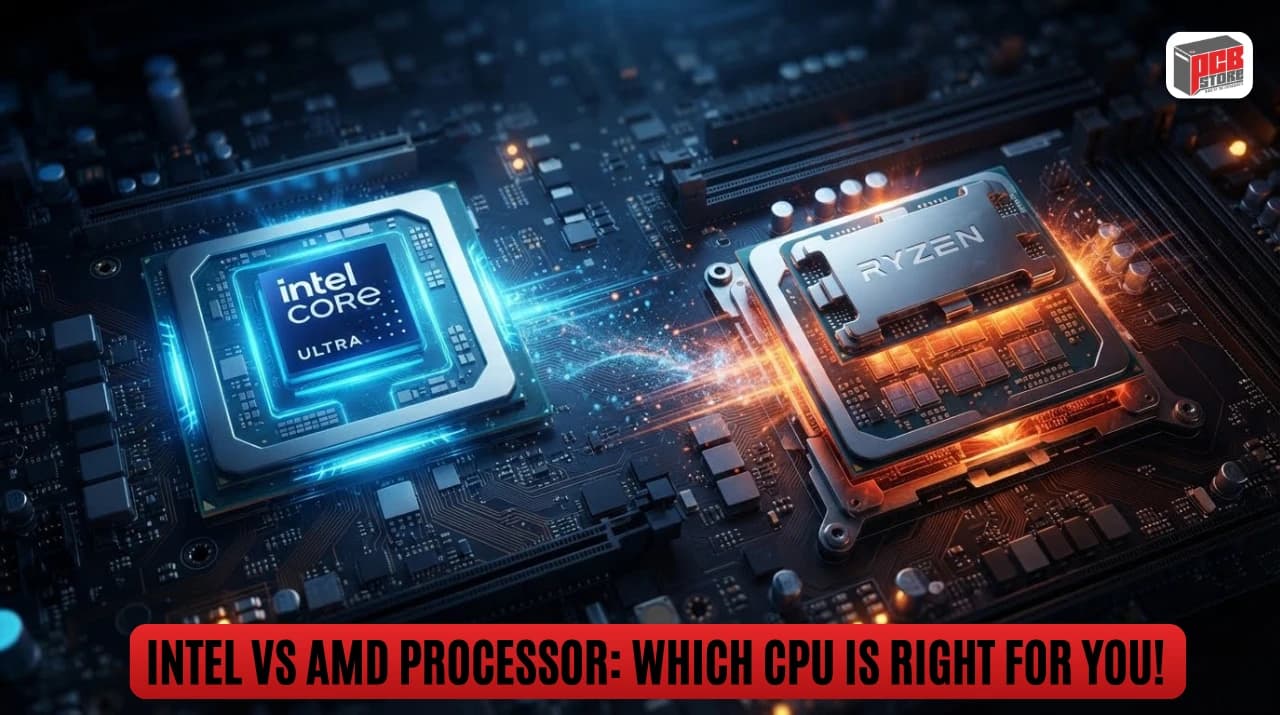
- Intel Ultra Series Platform: Next-generation architecture completely eliminates legacy memory pathways, executing operations exclusively via DDR5 infrastructure.
AMD Platform Compatibility
AMD enforces a rigid platform separation strategy that completely isolates its current desktop architecture from legacy standards.
- AM4 Ecosystem: Legacy platforms utilizing Ryzen 3000, 5000, or 5700X3D processors operate exclusively on DDR4 memory pathways.
- AM5 Ecosystem: Modern configurations using Ryzen 7000, 9000, or specialized 9800X3D processors function solely on DDR5 channels, offering no legacy structural compatibility.
Motherboard Selection Guide
Choosing a motherboard establishes a permanent boundary for your system memory options.
- Physical Slot Keying: Memory slots feature unique alignment notches that physically prevent a DDR4 module from fitting into a DDR5 motherboard slot.
- Model Identification: Board manufacturers explicitly designate memory generation compatibility in the product naming layout (e.g., "MSI B760M DDR4" vs "MSI B760M DDR5").
XMP vs EXPO Profiles
Unlocking the true rated performance of a retail memory kit requires navigating vendor-specific automated overclocking profiles in the system firmware.
- Intel XMP (Extreme Memory Profile): An automated preset utility optimized for Intel's ring bus architecture to instantly scale frequencies past default constraints.
- AMD EXPO (Extended Profiles for Overclocking): A specialized open-source protocol featuring tighter sub-timings specifically tuned for the Infinity Fabric interconnect layout on modern Ryzen processors.
- Cross-Platform Translation: Modern motherboards use firmware translation features to easily read XMP profiles on AMD motherboards or execute EXPO configurations on Intel boards.
Best DDR4 RAM Recommendations in Bangladesh
Selecting the correct DDR4 memory kit requires matching local market prices with reliable architectural timing specifications. The following selections provide the best balance of cost, stability, and speed across Bangladeshi retail networks.
Best Budget Option
The PNY XLR8 GAMING 8GB DDR4 3200MHz module stands out as the premier cost-effective option for basic system builds. Operating at the standard 1.2V profile, it provides stable baseline performance without requiring manual BIOS modification.
- Model: PNY XLR8 GAMING 8GB DDR4 3200MHz
- Capacity & Timing: 8GB Single DIMM | CL22-22-22-52
- Average Cost: BDT 7,500 – BDT 8,700
Best Gaming Option
For mainstream gaming setups, the PNY XLR8 Gaming 16GB DDR4 3200MHz delivers low CAS latency alongside a reliable low-profile heat spreader. It easily runs stable XMP 2.0 automated profiles across both older Intel and AMD platforms.
- Model: PNY XLR8 Gaming 16GB DDR4 3200MHz
- Capacity & Timing: 16GB Single-Channel Kit | CL16-18-18
- Average Cost: BDT 15,200 – BDT 17,000
Best Performance Option
The G.Skill Ripjaws V 32GB DDR4 3200MHz represents the absolute performance ceiling for legacy rigs requiring massive memory capacities. It integrates premium IC sorting to ensure maximum stability under sustained processing workloads.
- Model: G.Skill Ripjaws V 32GB DDR4 3200MHz
- Capacity & Timing: 32GB single-Channel Kit | CL16-18-18-38
- Average Cost: BDT 19,500 – BDT 21,000
Best DDR5 RAM Recommendations in Bangladesh
DDR5 component options focus on squeezing out maximum data throughput while managing the increased operating heat generated by built-in power management microchips.
Best Budget DDR5
The Crucial Classic or TEAM T-FORCE DELTA 16GB DDR5 6000MHz non-heatsink module provides a low-cost point of entry for modern processing architectures. It allows builders to adopt future-proof motherboard ecosystems without overextending their initial capital layout.
- Model: TEAM T-FORCE DELTA 16GB DDR5 6000MHz
- Capacity & Timing: 16GB Single DIMM | CL38-38-38-78
- Average Cost: BDT 27,200 – BDT 28,900
Best Gaming DDR5
G.Skill Ripjaws S5 or Kingston FURY Beast Non RGB 16GB kits configured to 6000 MT/s hit the absolute performance sweet spot for modern gaming platforms. The tight CL30 or CL36 timing latency metrics unlock peak frame pacing inside demanding open-world physics engines.
- Model: Kingston FURY Beast Non RGB 16GB 6000MHz
- Capacity & Timing: 32GB Dual-Channel Kit | CL36-44-44-96
- Average Cost: BDT 24,500 – BDT 26,500
Best Creator DDR5
Professional workloads including local AI rendering and heavy 4K composition require massive data densities. The G.Skill Trident Z5 RGB or Corsair VENGEANCE Non RGB 32GB DDR5 DRAM 6000Mhz high-speed configurations minimize processing bottlenecks under maximum thread saturation.
- Model: Corsair VENGEANCE Non RGB 32GB DDR5 DRAM 6000Mhz
- Capacity & Timing: 32GB Dual-Channel Kit | CL30 / CL38
- Average Cost: BDT 40,000 – BDT 43,000
Why Buy RAM From PCB Store in Bangladesh?
Purchasing system hardware from a verified local importer ensures long-term operational security for high-value PC builds. PCB Store serves as an authorized destination for desktop memory components in Bangladesh, maintaining strict consumer protections.
Product Authenticity and Genuine Brands
The local computer market frequently suffers from counterfeit component distribution and gray-market hardware modules. PCB Store sources memory kits directly from official channel pipelines, ensuring every DDR4 and DDR5 stick is a brand-new, factory-sealed product from global manufacturers.
Official Warranty Support
Memory modules are highly sensitive to power surges or controller defects, making localized warranty support mandatory. Purchases include complete official manufacturer replacement warranties, shielding buyers from costly repair fees and protracted transit timelines.
Access to Latest DDR4 and DDR5 Models
Evolving computing frameworks necessitate access to diverse memory configurations running at optimized speed intervals. The retail floor regularly refreshes stock inventories to display high-frequency 6000 MT/s EXPO kits alongside legacy low-profile modules.
Technical Guidance for Compatibility
Navigating Motherboard Qualified Vendor Lists (QVL) to secure memory stability requires deep technical understanding. Hardware specialists evaluate candidate configurations to guarantee your selected RAM interfaces seamlessly with specific processors and firmware.
Custom PC Build Assistance
Achieving visual harmony and structural performance balance demands systemic alignment across every hardware bracket. The assembly group guides buyers from initial component choosing through optimal dual-channel layout configurations during manual building.
Comparing Multiple RAM Brands in One Place
Sifting through fragmented spec sheets across isolated retail outlets hampers objective commercial analysis. Builders can evaluate pricing and latency layouts from Corsair, G.Skill, Team Group, and Crucial within a single interface.
DDR4 vs DDR5 – Final Verdict: Which One Should You Buy in 2026?
The definitive choice between DDR4 and DDR5 hinges directly on your total capital deployment limits and targeted software applications. System architecture planning must align with structural performance requirements rather than marketing generalizations.
Best Choice Under Budget
DDR4 represents the logical solution for baseline desktop configurations restricted to financial boundaries below BDT 70,000. It frees up essential capital that can be reassigned to improve core graphic processing units or faster system storage.
Best Choice for Gaming
Mainstream high-frame gaming deployments operating at 1080p or 1440p resolutions scale best using modern 6000 MT/s DDR5 kits. The rapid subchannel layout drastically reduces minimum frame pacing fluctuations in dense open-world multi-player environments.
Best Choice for Creators
Professional production machines running complex 3D tracking software or high-resolution timelines demand modern DDR5 platforms. The massive bandwidth increase cuts raw rendering times down while stabilizing active multi-threaded application previews.
Best Choice for Future-Proof Builds
Assembling a modern system with a structural lifecycle targeting the next five years mandates choosing DDR5. It guarantees compatibility with upcoming processor architectures, ensuring easy component upgrades without requiring total motherboard replacements.