Nvidia DGX Price in Bangladesh
Nvidia DGX
1
/1
Filter
Filter
Description
The landscape of artificial intelligence and high-performance computing in Bangladesh is evolving rapidly, with research institutions, pharmaceutical companies, telecommunications providers, and emerging tech startups demanding computational infrastructure that can handle the most demanding AI workloads.
NVIDIA DGX systems represent the apex of AI computing platforms, purpose-built from silicon to software to accelerate the full AI development lifecycle—from data analytics and model training to inference deployment.
For teams that are scaling from a single lab machine into serious infrastructure, starting with an AI Work Station Hpc roadmap helps align the right compute class with real workloads.
Understanding NVIDIA DGX Architecture
NVIDIA DGX systems are fundamentally different from assembling individual GPU servers or workstations. These are integrated AI supercomputers where every component—from the GPU interconnect fabric to the cooling solution and software stack—has been engineered specifically for AI workloads.
The DGX platform eliminates weeks of infrastructure setup and optimization that typically plague organizations building custom GPU clusters, especially those trying to combine high-core-count CPU platforms like AMD Threadripper for workstation builds or AMD EPYC and Intel Xeon for server-grade deployments.
The DGX Difference: Integrated AI Systems
At the heart of every DGX system is NVIDIA's NVLink and NVSwitch technology, creating a high-bandwidth, low-latency mesh network between GPUs that operates at speeds up to 900 GB/s bidirectional. This is fundamentally different from PCIe-connected GPUs, where inter-GPU communication becomes a bottleneck during model parallelism and large-scale training.
For transformer models exceeding 100 billion parameters—increasingly common in natural language processing and computer vision—this interconnect architecture is not just beneficial but essential.
The DGX software stack, including NVIDIA AI Enterprise, Base Command, and optimized containers for major AI frameworks (PyTorch, TensorFlow, JAX, RAPIDS), represents thousands of engineering hours of optimization.
Organizations attempting to replicate this level of integration with commodity hardware often underestimate the complexity involved in achieving optimal GPU utilization, memory management, and framework optimization—particularly when mixing different platforms, tuning BIOS settings, or selecting the right WorkStation Motherboard for stability under sustained AI loads.
DGX Model Lineup and Specifications
NVIDIA DGX H100:
The flagship system powered by eight H100 Tensor Core GPUs delivers 32 petaFLOPS of FP8 AI performance. With 640GB of total GPU memory and fourth-generation NVLink providing 7.2TB/s of all-to-all GPU communication bandwidth, the DGX H100 is designed for the most demanding generative AI models, including GPT-class language models, diffusion-based image generation, and protein folding simulations.
The Transformer Engine in H100 GPUs automatically manages precision for transformer models, achieving up to 6x speedup over previous generations. For buyers tracking the newest architecture direction, this progression also sets expectations for the Nvidia BlackWell era in performance-per-watt and next-gen scaling.
NVIDIA DGX A100:
Equipped with eight A100 GPUs delivering 5 petaFLOPS of AI performance, the DGX A100 remains highly relevant for production AI workflows, particularly for organizations that have optimized their pipelines around the A100 architecture.
The 640GB total GPU memory across eight 80GB GPUs, combined with third-generation NVLink at 600 GB/s per GPU, makes this system exceptional for recommendation systems, fraud detection models, and mid-scale language models.
NVIDIA DGX Station:
Designed as a personal AI workstation, DGX Station brings datacenter-class AI capabilities to individual researchers and small teams. Powered by four A100 GPUs in a tower form factor, it delivers 2.5 petaFLOPS while fitting under a desk and operating on standard office power (1500-1800W).
For Bangladeshi universities and research labs with limited datacenter infrastructure, DGX Station offers a practical entry point into serious AI development without requiring facility modifications—often comparable to building a premium workstation around AMD Threadripper plus high-end GPUs, but with much tighter integration and support.
NVIDIA DGX Spark:
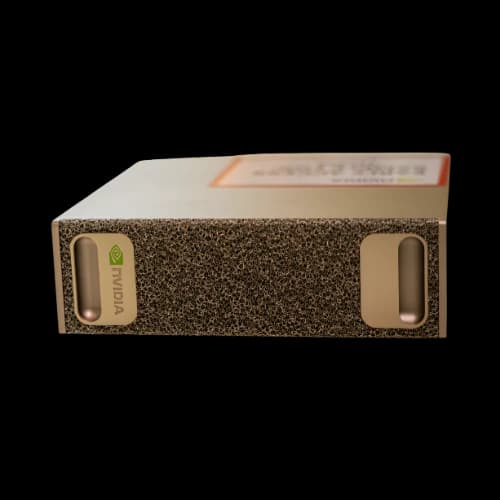
The latest addition represents NVIDIA's response to growing demand for accessible AI development platforms. Purpose-built for GenAI application development, prototyping, and inference serving, the DGX Spark configuration available at PCB Store balances performance and practical deployment.
It's particularly suited for startups building AI-powered SaaS products, financial institutions developing proprietary models, and healthcare organizations implementing diagnostic AI systems.
Real-World Applications in Bangladesh's Context
Pharmaceutical Research and Drug Discovery
Bangladesh's pharmaceutical industry, one of the fastest-growing sectors in South Asia, is beginning to adopt AI for drug discovery and molecular modeling. DGX systems accelerate molecular dynamics simulations that would take months on traditional CPU clusters to days or hours.
Companies using the NVIDIA BioNeMo framework on DGX systems can screen millions of molecular compounds against target proteins, predict drug-target binding affinities, and generate novel molecular structures optimized for specific therapeutic outcomes.
The computational requirements for running AlphaFold 2 for protein structure prediction or generating new molecular candidates using generative models are substantial. A single protein folding task that might require 48 hours on a high-end gaming GPU cluster can be completed in under 2 hours on a DGX A100, fundamentally changing the iteration speed of research programs.
For organizations building hybrid clusters, pairing DGX nodes with CPU-heavy servers based on AMD EPYC or Intel Xeon can also help accelerate data preprocessing and ETL pipelines.
Telecommunications and Network Optimization
Bangladesh's telecommunications sector handles massive datasets from millions of subscribers. DGX systems enable real-time network optimization, predictive maintenance of cell towers, customer churn prediction, and fraud detection at scale.
Training recommendation engines that personalize offers for 100+ million subscribers requires processing petabytes of interaction data—workloads where DGX's unified memory architecture and optimized data loading pipelines provide measurable ROI through reduced training time and improved model accuracy.
Financial Services and Fraud Detection
Banks and financial institutions require real-time fraud detection systems that process thousands of transactions per second.
DGX systems running NVIDIA Triton Inference Server can handle concurrent inference across multiple models—transaction anomaly detection, customer behavior profiling, document verification, and risk assessment—with latencies measured in single-digit milliseconds.
The ability to retrain fraud detection models daily rather than monthly makes the difference between catching new fraud patterns early and suffering losses. DGX systems' training performance enables this rapid iteration cycle that CPU-based systems cannot economically support.
Academic Research and Education
Leading universities in Bangladesh are establishing AI research centers focused on Bengali NLP, climate modeling, agricultural optimization, and medical imaging.
Training a Bengali language model on 100GB+ of text corpus, or processing satellite imagery for crop yield prediction across Bangladesh's agricultural regions, demands computational resources that traditional research infrastructure cannot provide.
DGX systems allow researchers to compete globally, publishing papers that require state-of-the-art model architectures and training scales. In many cases, labs begin with an AI Work Station HPC setup for experimentation before transitioning into dedicated DGX infrastructure.
Computer Vision and Manufacturing Quality Control
Bangladesh's garment industry, representing over 80% of export earnings, is increasingly adopting AI-powered quality control systems. DGX platforms enable training custom object detection models on millions of garment images to identify defects with superhuman accuracy.
These systems must process high-resolution images in real-time factory environments, requiring optimized inference pipelines that DGX systems excel at delivering through TensorRT optimization and multi-model serving capabilities.
Where visualization and CAD workflows overlap with AI inspection, some factories also maintain separate graphics-oriented GPU systems like Nvidia Quadro alongside DGX-based training and inference backends.
DGX Buying Guide: Technical Considerations for Bangladesh
Assessing Your Computational Requirements
Start with Workload Analysis: Before selecting a DGX configuration, profile your current and projected AI workloads. Are you primarily training large language models, running computer vision pipelines, or performing data analytics at scale?
Language models with billions of parameters require maximum GPU memory and inter-GPU bandwidth, favoring DGX H100 or A100 configurations. Computer vision workloads with smaller models but higher throughput requirements might perform excellently on DGX Station or Spark configurations.
Model Size and Batch Size Considerations: Calculate your model's memory footprint.
A transformer model with parameters P using FP16 precision requires approximately 2P bytes just for parameters, plus activation memory that scales with batch size and sequence length. If your target model is 70 billion parameters, you need 140GB minimum for parameters alone, plus activation memory—making the 80GB A100 or H100 essential for single-GPU training or 40GB variants for model-parallel approaches.
Training vs. Inference Balance: Organizations focused primarily on deploying existing models (inference) have different requirements than those developing proprietary models (training).
Inference workloads benefit from higher GPU count for parallel serving but can often use smaller memory configurations. Training large models demands both memory capacity and inter-GPU bandwidth.
Infrastructure and Facility Requirements
- Power and Cooling in Dhaka's Climate: DGX H100 requires 10.2 kW peak power per system, while DGX A100 draws approximately 6.5 kW. In Dhaka's tropical climate with average temperatures 25-35°C, maintaining optimal operating conditions (18-27°C) requires robust datacenter cooling. Factor in approximately 1.4-1.6x the system power draw for cooling overhead when calculating total facility requirements.
- Network Infrastructure: DGX systems include high-speed InfiniBand or Ethernet networking for clustering multiple units and accessing shared storage. If you plan to scale beyond a single DGX, invest in NVIDIA Quantum InfiniBand switches or high-speed Ethernet infrastructure. For single-system deployments, ensure your network can support the data ingest requirements—training on large datasets requires sustained multi-gigabit storage access.
- Uninterruptible Power Supply: Bangladesh's power infrastructure, while improving, still experiences occasional fluctuations. Protect your DGX investment with enterprise-grade UPS systems rated for the full system load plus 20% headroom. Budget for 15-20 minutes of runtime to allow graceful shutdown during extended outages.
Software Ecosystem and Talent Availability
- Framework Compatibility: DGX systems support all major AI frameworks, but verify your team's existing expertise. If your data scientists work primarily in PyTorch, leverage NVIDIA's optimized PyTorch containers. TensorFlow users benefit from automatic mixed precision and XLA optimization in TF containers. Organizations using JAX for research should verify version compatibility with DGX software releases.
- Talent Pool Considerations: Bangladesh has a growing pool of AI talent, with graduates from BUET, DU, NSU, and other institutions increasingly proficient in modern AI frameworks. However, expertise in distributed training, GPU optimization, and infrastructure management is less common. Factor in training costs or consider managed AI platform services that abstract some of the complexity.
- Development Velocity: Calculate the value of faster iteration. If your team currently waits 3 weeks for a model training run that DGX could complete in 2 days, the productivity gain often justifies the investment within months, especially when factoring in the opportunity cost of delayed product launches or research publications.
Budget and Total Cost of Ownership
- Upfront Capital vs. Cloud Alternatives: Compare DGX acquisition cost against equivalent cloud GPU instances over your planning horizon (typically 3-5 years). For continuous workloads, owned infrastructure often reaches cost parity with cloud within 12-18 months. For intermittent workloads or exploration phases, cloud may be more cost-effective initially.
- Maintenance and Support: NVIDIA Enterprise Support provides critical firmware updates, security patches, and technical support. For organizations without deep GPU systems expertise, this support is invaluable. Budget approximately 12-15% of system cost annually for comprehensive support contracts.
- Electricity Costs: At Dhaka's commercial electricity rates (approximately 9-12 BDT per kWh for industrial connections), a DGX H100 running continuously costs roughly 73,440-97,920 BDT monthly in electricity alone (10.2 kW × 720 hours × 10 BDT average). Include cooling overhead, and this increases to approximately 110,000-150,000 BDT monthly. This operational cost should factor into ROI calculations.
Scalability Path
- Single System Considerations: Many organizations start with a single DGX system. Ensure your selected configuration can scale through clustering. DGX systems with InfiniBand interconnect can be linked into multi-system clusters for workloads exceeding single-system capacity, providing an upgrade path as needs grow.
- Storage Architecture: Don't underestimate storage requirements. Training datasets often exceed multiple terabytes, and model checkpointing requires high-speed storage. Plan for NVMe-based shared storage accessible at multi-GB/s speeds. NVIDIA DGX SuperPOD includes reference storage architectures that can be scaled from single-system to cluster deployments.
Regulatory and Compliance Factors
- Data Residency: For organizations in regulated sectors (banking, healthcare, telecom), on-premises DGX systems ensure data never leaves Bangladesh's borders, addressing data residency requirements that cloud deployments may complicate.
- Security and Audit: DGX systems with NVIDIA AI Enterprise include security features like secure boot, attestation, and vulnerability scanning. For organizations subject to security audits (financial institutions, government contractors), these built-in capabilities reduce compliance overhead.
Why Choose PCB Store for Your NVIDIA DGX Investment?
PCB Store brings deep, enthusiast-grade expertise to enterprise AI systems. Our team understands DGX platforms at the architectural level—NVLink behavior, thermal management in Bangladesh’s climate, CUDA optimization, and multi-node scaling—so you get practical guidance, not just a box delivery.
When you’re investing from several lakhs to multiple crores, that depth matters for choosing the right configuration and extracting real performance from day one—whether you’re comparing DGX against a custom build using AMD EPYC, Intel Xeon, or a high-end AI Work Station HPC stack.
Beyond installation, PCB Store provides ongoing, in-time-zone technical support and optimization.
We offer flexible procurement options, access to the broader NVIDIA ecosystem (tools, training, and enterprise support), and continuous performance tuning as your models and data scale—reducing risk and maximizing the return on your DGX investment, including planning for next-gen compute transitions such as Nvidia BlackWell.