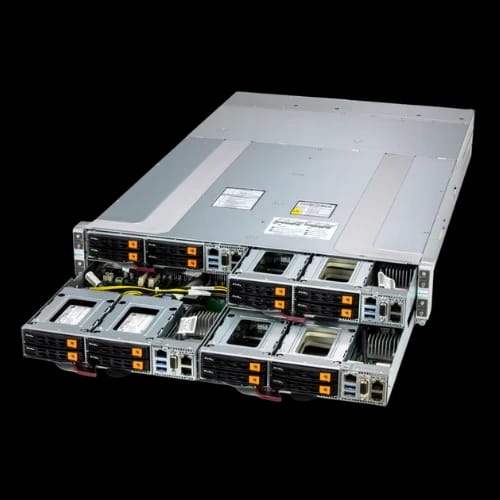
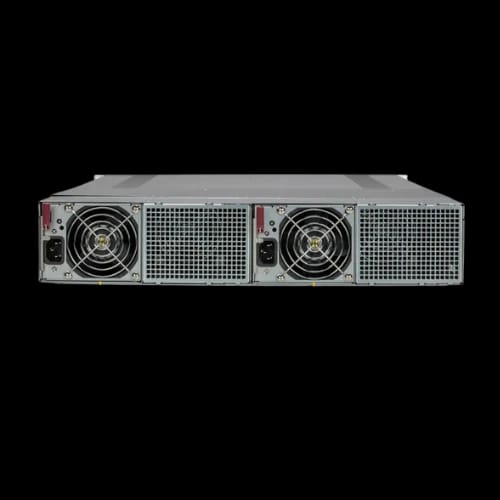
AMD EPYC 4-Node Rack Server
Key Features
- AMD EPYC SP5 Platform: Up to 192C/384T
- Massive DDR5 Memory: Up to 4TB per Node
- Quad Hot-Swap Nodes: Independent 2U Design
- Titanium PSU Redundancy: 96% Efficiency, 2200W
- Enterprise Security: TPM 2.0, NIST 800-193 RoT
- Form Factor: 2U 4-Node Rackmount
- Storage: Hot-swap NVMe/SATA
Share:
Any Questions? Ask On
Technical Specifications
System Overview
Processor (Per Node)
Memory (Per Node)
Storage & Expansion
I/O & Networking
Power & Cooling
Security
Dimensions
Warranty Information
Product Description
AMD EPYC 4-Node Rack Server (2U GrandTwin)
Your data center is running out of space — and the AMD EPYC 4-Node Rack Server is how you put four full servers in a single 2U slot. This is not a spec sheet upgrade. This is an architectural shift in how you deploy compute density for HPC, cloud gaming, Telco edge, and enterprise workloads. If you've been searching for a high-performance AMD EPYC server price in Bangladesh that actually justifies the investment, this GrandTwin platform deserves your full attention.
What Is the AMD EPYC 4-Node 2U GrandTwin Rack Server?
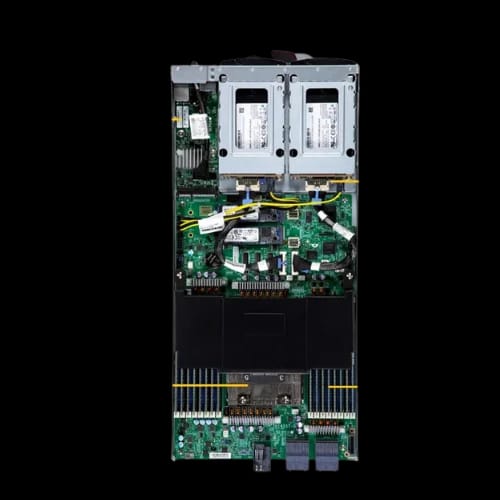
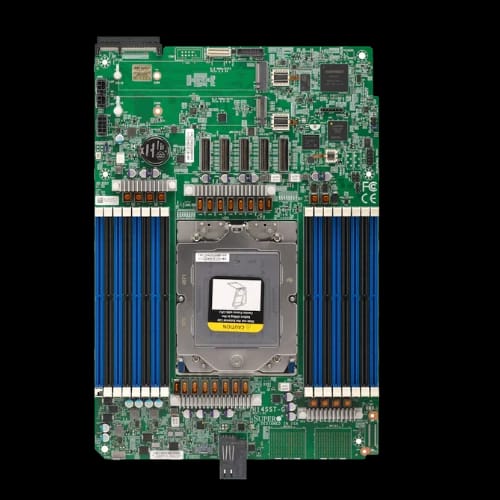
The AMD EPYC 4-Node Rack Server packs four independent, hot-pluggable compute nodes into a single 2U rackmount chassis. Each node runs its own AMD EPYC 9005 or 9004 Series processor on a dedicated Supermicro H14SST-G motherboard. Four complete servers. One rack unit footprint. That's the core promise — and it delivers.
The chassis model is the CSE-GT214BF-R2K21BP, measuring 88mm in height and 711.2mm in depth. At a gross weight of 39.9 kg, this is serious iron built for serious infrastructure. PCB Store carries this platform for data center operators, system integrators, and enterprise IT teams across Bangladesh looking for best-in-class AMD EPYC rack server density.
AMD EPYC 4-Node Rack Server Specs: Performance Overview
Every node in this system is built around the AMD EPYC 9005/9004 Series single-socket SP5 processor, supporting up to 192 cores and 384 threads with up to 384MB cache. TDP support reaches 400W, which means you can load these nodes with the highest-core-count EPYC silicon currently available.
Memory per node scales aggressively:
- 16 DIMM slots supporting up to 2TB DDR5 ECC RDIMM in 1DPC configuration at 5200 MT/s (EPYC 9005)
- 2DPC configuration pushes that to 4TB per node at 4400 MT/s
- ECC protection across all memory channels — critical for banking, cloud, and EDA workloads
Across all four nodes, you're looking at up to 8TB of total ECC DDR5 RAM in a single 2U slot. For workloads like Electronic Design Automation (EDA) or Multi-Access Edge Computing (MEC), that kind of per-chassis memory density is hard to find elsewhere. Compared to a standard AMD EPYC 64 Core 2U Rack Server, this GrandTwin config gives you four independent memory domains — far more flexible for multi-tenant deployments. And if you're weighing the AMD EPYC 8-Node Rack Server for maximum node density, keep in mind the 4-Node holds significantly more per-node headroom: up to 4TB RAM and 400W TDP per node versus the thinner profiles typical in 8-node configurations.
Key Features of the AMD EPYC 4-Node 2U Rack Server
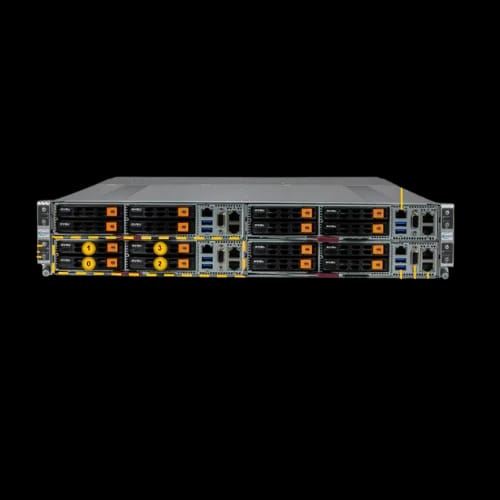
Four Hot-Pluggable Nodes in 2U
Each compute node is fully independent and hot-swappable. You can service, swap, or upgrade one node without affecting the others. For operators running 24/7 uptime requirements, this is not a luxury — it's a necessity.
Front I/O and NVMe/SATA Storage Per Node
Each node gets 4 front hot-swap 2.5" NVMe/SATA drive bays plus 2 onboard M.2 NVMe/SATA slots (M-key 2280/22110). That covers OS drives, cache tiers, and local storage simultaneously. When comparing NVMe SSD options or SAS SSD drives for this platform, PCB Store's server storage specialists can guide the right SKU selection.
Flexible Networking via AIOM
Networking is handled through an OCP 3.0-compatible PCIe 5.0 x16 AIOM slot per node. This opens the door to 25GbE, 100GbE, or InfiniBand connectivity depending on your fabric requirements. For Telco Edge and CDN deployments, that flexibility matters.
Titanium-Level Power Efficiency
The dual 2200W redundant (1+1) power supplies carry a Titanium Level 96% efficiency rating. Input ranges cover 100V to 240V AC, making this system deployable in Bangladesh's grid environment without issue. Server power supply quality at this efficiency tier directly cuts operational cost over a 3–5 year datacenter lifecycle.
Security, Firmware, and Platform Integrity
The AMI 64MB SPI Flash BIOS on each node supports a full hardware security stack:
- TPM 2.0 and Silicon Root of Trust compliant with NIST 800-193
- Cryptographically Signed Firmware and Secure Boot
- Automatic Firmware Recovery and Supply Chain Remote Attestation
- Runtime BMC Protections with System Lockdown capability
For IT firms, banks, and government infrastructure operators in Bangladesh, these aren't just checkboxes. They're the compliance requirements for any serious procurement process. This level of security architecture puts this server in a different category from a basic Intel Xeon server or a commodity AMD EPYC barebone unit.
Who Should Deploy This Server?
Cloud Service Providers and CDN Operators
The node-level isolation and per-node NVMe storage make this ideal for Multi-Purpose CDN and multi-tenant cloud deployments. You get physical separation with shared chassis economics.
HPC and EDA Teams
Up to 192 cores per node with 4TB ECC DDR5 memory headroom handles simulation-heavy EDA and HPC workflows without bottlenecks. Engineering firms and semiconductor design teams will recognize this configuration immediately.
Telco and Edge Computing Deployments
MEC and Telco Edge workloads demand low-latency local compute with high availability. The hot-swap node design and redundant power supply architecture align perfectly with carrier-grade uptime expectations.
Cloud Gaming Infrastructure
Densely packed compute in a 2U chassis is exactly what cloud gaming backend clusters need. The per-node PCIe 5.0 AIOM slot supports the high-bandwidth GPU add-in cards used in cloud gaming rendering nodes.
Enterprise IT and System Integrators in Bangladesh
Whether you're building a private cloud for a financial institution, deploying HPC for a research institute, or standing up edge nodes for a telecom operator, this server covers the brief. PCB Store supports enterprise buyers across Bangladesh with pre-sales consultation, configuration guidance, and post-purchase technical support.
Thermal Management and Chassis Cooling
Each node runs up to two 8cm heavy-duty fans rated at 17,600 RPM with PWM control and tachometer monitoring. The system actively tracks CPU temperature, VRM temperature, memory temperature, chassis environment, and multiple voltage rails including +12V, +5V, +3.3V, and 1.8V standby.
Operating temperature range is 10°C to 35°C with 8–80% non-condensing relative humidity — standard for a controlled data center environment. Compared to passive-cooled Server Barebone configurations, this active cooling architecture handles 400W TDP CPUs without thermal throttling.
Availability, Warranty, and After-Sales Support at PCB Store
The AMD EPYC 4-Node Rack Server is available now at PCB Store — one of the most trusted destinations for server and NAS prices in Bangladesh. Whether you're pricing an AMD EPYC 64 Core 2U Rack Server for a baseline deployment or stepping up to this 4-Node GrandTwin for full workload density, PCB Store carries the lineup and the expertise to match you to the right build. For enterprise buyers needing a project-specific quote, contact PCB Store directly — pricing varies by node configuration, memory density, and storage options selected.
PCB Store provides reliable after-sales service across Bangladesh. The team handles warranty claims, technical issues, and product support directly. For a platform this complex — covering server rack integration, ECC RAM selection, SAS SSD or NVMe storage configuration, and network card pairing — having local expert support is not optional.
Do not let a 2U slot become a bottleneck. Four nodes. One chassis. Zero compromise. Get yours configured at PCB Store today.
Delivery Charge Info
Inside Dhaka: ৳1,500
Outside Dhaka: ৳2,500
FAQs
What processors are compatible with the AMD EPYC 4-Node Rack Server?
It supports AMD EPYC 9005 and 9004 Series processors in a single Socket SP5 configuration per node. CPUs up to 400W TDP are supported, covering the full performance range of the current EPYC lineup.
How much RAM can each node in this 4-Node Rack Server support?
Each node has 16 DIMM slots. With EPYC 9005 at 2DPC, you can install up to 4TB of ECC DDR5 RAM per node. Across all four nodes, that's up to 16TB total system memory in one 2U chassis.
Does each node have independent hot-swap storage bays?
Yes. Each node has 4 front-accessible hot-swap 2.5" NVMe/SATA bays plus 2 M.2 slots. Nodes operate independently, so you can swap drives in one node without interrupting the others.
What is the power consumption of the AMD EPYC 4-Node Rack Server?
The chassis uses dual 2200W Titanium Level (96% efficiency) redundant power supplies in a 1+1 configuration. Actual draw depends on CPU TDP and workload configuration across the four nodes.
AMD EPYC 4-Node Rack Server vs AMD EPYC 8-Node Rack Server — which should I choose?
The 4-Node server prioritizes per-node compute density with full EPYC SP5 processors and up to 4TB RAM per node. The 8-node variant trades individual node power for higher node count. Choose 4-node for memory-intensive or high-TDP workloads; 8-node for lighter, distributed tasks.
Is this server suitable for HPC and EDA workloads?
Absolutely. With up to 192 cores, 384MB cache, and 4TB DDR5 per node, it handles memory-bound HPC simulation and EDA tools like Synopsys or Cadence without compromise. It's one of the most capable 2U platforms for these use cases.
What is the AMD EPYC 4-Node Rack Server price in Bangladesh, and is it available at PCB Store?
PCB Store carries the AMD EPYC 4-Node Rack Server in Bangladesh with competitive pricing and local after-sales support. Contact PCB Store directly for the current EPYC server price in Bangladesh and stock availability.
Does this 4-Node Rack Server support NVMe drives?
Yes, each node supports NVMe in the front hot-swap 2.5" bays and M.2 slots. NVMe/SATA support for the hot-swap bays requires additional parts from the optional parts list — PCB Store can advise on the correct configuration.
Can this server be used for cloud gaming or Telco Edge deployments in Bangladesh?
Yes. The node-isolated architecture, low-latency EPYC compute, and flexible AIOM networking make it a strong platform for MEC (Multi-Access Edge Computing), Telco Edge, and cloud gaming infrastructure — all key application areas for this server class.
Related Products
৳715,000
৳3,150,000
Popular Products